
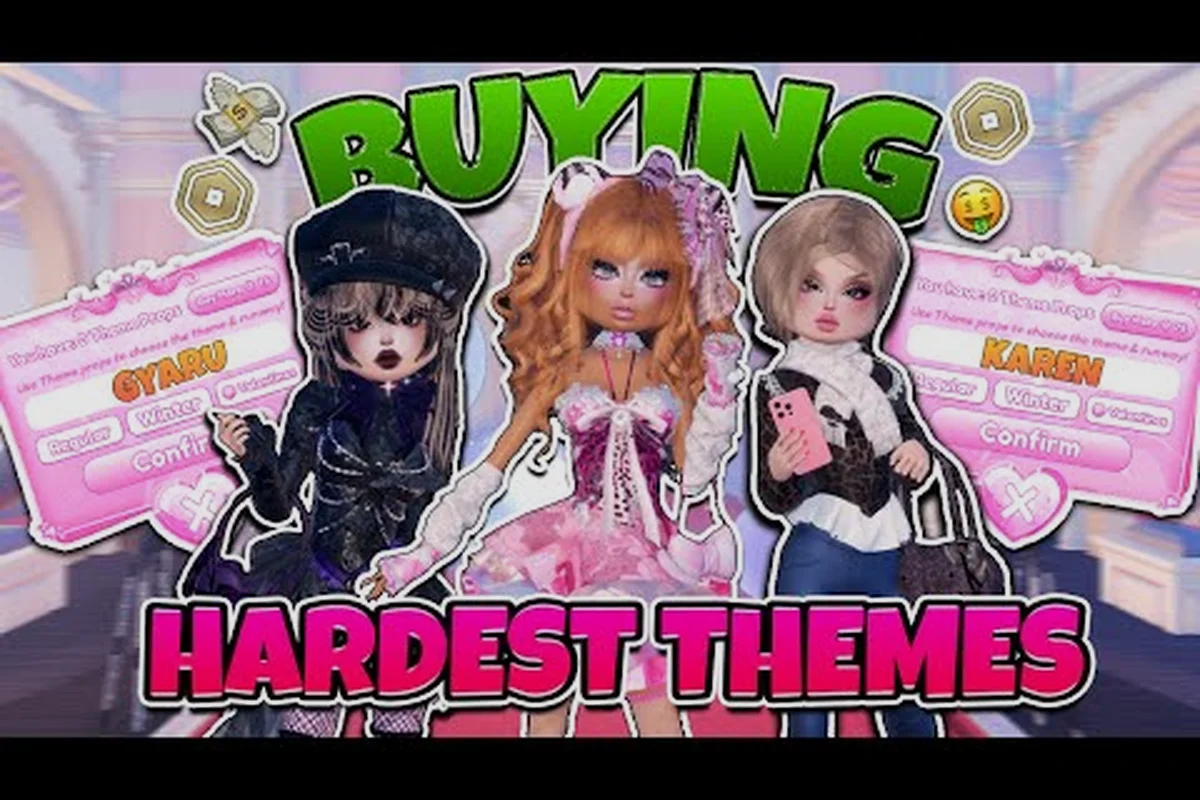
Some rounds in Dress To Impress feel like a vibe check you didn't study for, and the hardest themes are the ones that punish vague styling, thin color stories, and lazy layering. Surviving the trickier prompts from the Wicked collab, the 2026 culture waves, and the long-tail aesthetic deep cuts requires a deliberate layering plan, a tight color formula, and a few pivot tricks that turn "I have no idea what to wear" into a confident runway walk. This guide breaks down which themes consistently trip players up, why those rounds are hard, and the exact moves that get you top-three votes even when the prompt lands cold.
What Counts As A Hard Theme In Dress To Impress
A round earns "hard" status when the prompt leaves too much room for interpretation, demands niche wardrobe pieces most players haven't saved, or requires a specific silhouette that collides with whatever the theme wheel already queued you into. According to community data on the Dress To Impress Fandom wiki, the game now runs hundreds of themes ranging from clean staples like Y2K and Old Money to layered prompts like Wicked, Brat, and regional culture tags that newer players rarely have saved as presets.
Three conditions reliably push a theme from "tough" into "hardest": layered interpretive prompts like Wicked or Avant Garde where voters split on canon, wardrobe-thin asks that require VIP drop or seasonal event pieces the average player never saved, and brutal runways where nine of ten outfits land on the same silhouette and a single missing accessory demotes you out of the top three on the leaderboard.
-
The prompt is abstract or interpretive (Brat, Avant Garde, Dark Academia) where voters disagree on what "correct" means
-
The wardrobe is wardrobe-thin, meaning the required pieces only exist in newer updates, VIP drops, or seasonal events players missed
-
The runway is crowded with similar reads, so a single missing accessory drops you out of the top three
Hard themes almost never punish the player who planned ahead. They punish the player who shows up to the dressing room with a flat template and a wish — someone who ignored the Wicked prep notes, never farmed the Brat green accessories from the seasonal drop, and treats the Avant Garde silhouette bracket as optional. Top-tier players treat every hard theme as a wardrobe audit beforehand: they screenshot the theme, check which pieces overlap with their saved presets, and swap out the riskiest reads before the runway timer starts, which is exactly what the rest of this guide turns around.
The Hardest Themes Players Are Hitting Right Now
Across the October 2026 meta, the five pain points below each punish a different mistake category — silhouette misreads (Wicked, Avant Garde), vibe gaps with no clean template (Brat), wardrobe thinness (World Culture Day), and layered-academia ambiguity (Dark Academia) — and the table pairs every theme with its core failure mode plus the single fastest dressing-room fix, so you can jump straight to the row that matches your current round instead of guessing which piece to swap first.
| Theme | Why It Tops The Hardest List | Fastest Survival Move |
|---|---|---|
| Wicked (Glinda / Elphaba) | Specific green-and-pink silhouettes, hat tiers, broom accents | Save a Glinda and an Elphaba preset before the round queues |
| Brat | Vibe-based, lime green anchor, messy texture, no clean template | Lead with the green base, then break one silhouette rule on purpose |
| Avant Garde | Asymmetry, exaggerated proportions, no "right" answer | Pick one shape and stretch it 30% beyond the default |
| World Culture Day (regional) | Wardrobe-thin unless you saved pieces from the Trip to Tokyo wave | Pre-build culture presets during off-season rotation |
| Dark Academia | Voters disagree on "ivy" vs "tortured poet," reads as a generic turtleneck if you skip layering | Stack two textures (knit + leather or knit + wool) and add a single gold accent |
Wicked Themes And The Green-Pink Trap
The Wicked collab dropped two anchor characters with a tight color code, and the runway is unforgiving when you only sort-of hit the palette. Community data reported by players shows that the top-voted Elphaba builds almost always use a dark moss green as the base rather than neon, while Glinda builds survive on a pastel pink shell + crown combo that can survive a bad hair roll. The Lady Gaga update and Wicked collaboration coverage walks through the exact new sets that ship with this theme, which matters because pre-update pieces almost never earn first place on a Wicked round anymore.
Three habits separate a winning Wicked run from a middle-of-pack one, and each one attacks a different failure mode that the community's voting data has already exposed — wasted dressing-room time, misread silhouettes, and a costume piece that breaks the theme's color contract. The breakdown below moves in the order you should actually execute them, starting with preset saves before the timer starts and ending with the broom-vs-hat trade-off that trips up most Elphaba attempts.
-
Pre-save both character presets in the dressing room while you're still warm, not in the middle of the round when the clock is moving
-
Match the silhouette to the role — Glinda reads as puffy shoulders and structured skirt, Elphaba reads as long lines and dark textures
-
Skip the broom if you don't have the matching one; a hat without the broom still scores higher than a broom without the hat
Brat And Other Vibe-Based Themes
Brat is the round that exposes players who build by template. The whole theme is lime green, slightly rumpled, and confident in a way that a clean "Old Money" preset simply cannot fake. Players who win the Brat round usually lead with the brat green base layer, then deliberately break one rule — untucked shirt, mismatched shoe height, or a single bright accessory — so the read feels intentional instead of accidental.
The trick with vibe prompts is that voters reward commitment. A Brat look that is fully green and slightly messy beats a "tasteful green outfit" every time, because tasteful reads as a hesitation. When the theme wheel lands on Brat, you have about forty seconds to commit: pick the green, break the line, save the pose, and walk.
The Easiest Themes To Build When The Wheel Spins Cold
Knowing the easy side of the difficulty curve is half the battle, because it tells you which presets to save first and which themes to practice when the queue is quiet. The table below ranks the easiest themes based on wardrobe density, voter agreement, and how forgiving the runway is when one piece is missing.
| Theme | Why It Stays Easy | Starter Pieces Most Players Already Own |
|---|---|---|
| Y2K | Pink, low-rise, logo, repeat | Low-rise bottoms + baby tee + tinted shades |
| Beach Day | Bikini + cover-up + sun hat | Any swim top, sarong, sandals |
| Old Money | Neutral, structured, gold accents | White button-down, tailored trousers, pearls |
| Coquette | Pink + bows + dainty layers | Ballet flats, ribbon hair, soft cardigan |
| Mall Goth | Black base + band tee + chains | Black jeans, dark boots, leather cuff |
These are the rounds you can build in under sixty seconds if your wardrobe has the basics. If you don't, a quick browse through active Dress To Impress codes usually nets a few starter pieces that fill the gaps without spending Robux, and community testing confirms that code drops often target these easy categories first.
Building An Easy-Theme Template That Wins
Easy themes still have a winning order, and the order matters. For Y2K, the template is low-rise bottom + fitted top + tinted lens + logo accent, in that order. Skip any one of those and you fall into the "casual pink outfit" trap that middle-of-pack Y2K builds always hit. Beach Day survives on swim + cover + sun hat + sandals, where the cover is the piece most players forget, and the hat is the piece most players grab in the wrong color.
The lesson is that easy themes look easy only because someone chose the right anchor first, and Y2K is the clearest proof. The fitted top works as the anchor because it locks the silhouette before tinted lens and logo accent are even considered, removing the temptation to chase the trendiest piece. Save the low-rise bottom + fitted top + tinted lens + logo accent order to your template slot the moment a Y2K round pops up in the theme wheel, so you lock the core four before the 60-second timer starts eating into accessory swaps. Players who freestyle the same theme routinely burn 20+ seconds swapping a logo belt for a tinted visor they could have placed first.
New Themes 2026 And The Wardrobe Gap Problem
The 2026 update pipeline reshuffled the theme wheel, and several prompts now require pieces that didn't exist six months ago. The Dress To Impress 2026 update pipeline coverage breaks down every wave since the Halloween 2025 drop, but the themes that show up in the current rotation pull from the Tokyo wave, the Brat update, the World Culture Day cycle, and the Wicked collaboration. Players who skipped any of those drops walk into the round with a wardrobe gap they can't fill in forty seconds.
Culture Themes And The Regional Wardrobe Trap
Culture-themed rounds (World Culture Day, regional prompts, the Trip to Tokyo carry-overs) are among the newest dress to impress culture themes, and they're also the ones players complain about most. The reason is that "culture" is a wide umbrella: a Japanese prompt and a Brazilian prompt need entirely different palettes, fabrics, and silhouette cues, and most saved presets only cover one of them.
Community testing suggests that the most reliable survival tactic is to build a culture rotation instead of one culture preset. Save two to three anchor looks per region (a Tokyo street look, a Tokyo formal look, a Tokyo soft look), and you'll survive whichever sub-prompt the wheel lands on. The Trip to Tokyo and World Culture Day coverage maps which sets belong to which prompt, which matters because a kimono top and a Tokyo street jacket do not read as the same culture round even when both come from the same update wave.
The Wicked Carry-Over Effect
Because the Wicked collab is so anchor-heavy, every other green-and-pink theme in 2026 has quietly gotten harder. A "fairy" prompt now competes with Elphaba builds, and a "pastel queen" prompt now competes with Glinda builds, so culture-adjacent rounds inherit the Wicked standard even when the prompt itself isn't Wicked. Players who saved both Wicked presets before the wave now have a head start on at least three other themes, which is why the pros treat Wicked not as one theme but as a preset library that pays dividends across the rest of the rotation.
Smart Layering Tricks For Hard Theme Rounds
Layering is the single highest-leverage skill on hard rounds, because most players can find one or two theme pieces but cannot stack them into a silhouette that reads as intentional. The table below maps the most reliable layering patterns, what they fix, and which hard themes each one targets.
| Layering Pattern | What It Fixes | Hard Themes It Solves |
|---|---|---|
| Knit base + leather overshirt | "Boring" reads on dark academia and old money | Dark Academia, Old Money, Brat |
| Sheer overskirt + structured underskirt | Flat silhouette on fairy and coquette rounds | Fairy, Coquette, Wicked (Glinda) |
| Patterned pant + solid top | Visual heaviness on Y2K and street | Y2K, Streetwear, Mall Goth |
| Long coat + short dress | "Costume-y" reads on regal and royal | Royalty, Regency Era, Avant Garde |
| Sleeve mismatch (one bare, one covered) | Symmetry trap on avant garde and brat | Avant Garde, Brat, Avant Garde Goth |
The knit-plus-leather pattern is the most universal. It works on Dark Academia because voters read the texture contrast as "intentional layering" instead of "I just grabbed a sweater," and it works on Old Money because the leather pulls the look out of "casual" without breaking the palette. Players who master this single combination can survive roughly a third of the hard-theme rotation with no other change to their wardrobe.
The Color Formula That Wins On Culture And Wicked Rounds
Color is the most underrated layer, because most players treat it as a starting point instead of a constraint. The reliable formula for hard culture and Wicked rounds is one anchor + one supporting + one accent, where the anchor covers 60% of the silhouette, the supporting covers 30%, and the accent is a single piece — usually a hat, a bag, or a shoe. Anything more than three colors and the runway starts to feel busy; anything less and the look reads as a single-color block that voters interpret as a lazy template.
For Elphaba, the formula is dark moss (60%) + black (30%) + gold (10%). For Glinda, it is pastel pink (60%) + cream (30%) + silver sparkle (10%). For Tokyo street, it is black (60%) + accent color (30%) + white sneaker (10%). The math is the same every time, and the discipline of sticking to three colors is what separates the top-voted builds from the middle-of-pack ones.
Runway Pivots When Your First Read Was Wrong
Even with a good plan, the theme wheel sometimes lands on a prompt your wardrobe was not built for, and the only winning move is a fast pivot. Three pivot tricks work in the dressing room and they don't require any extra wardrobe pieces.
-
Swap the hat, not the body: changing the hat is the fastest way to shift a look between two adjacent themes (Old Money to Royalty, Brat to Mall Goth) without rebuilding the whole outfit
-
Color flip in one piece: swapping a single colored layer for its neutral opposite can pivot a look from "fairy" to "goth" in under ten seconds
-
Pose as the differentiator: when the body reads the same as everyone else's, a confident pose with a sharp walk cycle is what tips the vote
The pose trick is the most underused. Players who spend the first thirty seconds of a round on a complicated outfit and the last ten on a lazy walk almost always lose to players who spent twenty seconds on a clean outfit and twenty on a sharp pose, because voters read the runway in a single pass and the pose is the last thing they see.
When To Abandon The Round And Farm Stars
A small number of themes are so wardrobe-thin that no pivot trick will save them without a preset. If you can recognize these rounds early, you can save the loss and farm stars on a quicker theme instead. According to community data, the round types most worth skipping are the ones that require a single specific named item (a celebrity outfit, a holiday costume, a video game character) that your wardrobe does not contain. A re-roll and a star-farming round will net you more long-term progress than a stubborn loss on an unwinnable prompt.
Frequently Asked Questions
What are the Dress To Impress hardest themes right now?
According to community testing, the current hardest themes are Wicked (because the color and silhouette standard is so specific), Brat (because it's a vibe prompt with no clean template), and the regional World Culture Day rounds (because wardrobe pieces are thin outside the original update). Pre-saving presets for each of these is the fastest way to turn them into easy rounds.
Which Dress To Impress themes are easiest for new players?
The easiest themes for new players are Y2K, Beach Day, Old Money, Coquette, and Mall Goth. Each one uses wardrobe pieces most players already own, has a forgiving runway, and rewards a simple layering template. Save presets for these five first and you can survive the early ladder without spending Robux.
What new themes 2026 should I prep for in the dressing room?
The new themes 2026 added through the year include the Wicked collab, the Brat prompt, the World Culture Day regional cycle, and the Tokyo carry-overs. Save a Glinda preset, an Elphaba preset, a lime-green Brat base, and at least two regional culture presets before the next theme wheel rotation, because these prompts appear in roughly half of all hard rounds right now.
How do I beat a Wicked theme when I don't own the collab pieces?
You can still score in the top half of a Wicked round without the official collab pieces, as long as you hit the color formula (dark moss for Elphaba, pastel pink for Glinda) and the silhouette (long lines for Elphaba, structured puff for Glinda). The Fandom theme fallback list tracks fallback pieces that approximate the Wicked silhouette using older wardrobe items, which can carry you until the next code drop or seasonal event unlocks the real sets.